Blog· August 27, 2026
I’ve sent email for 20 years. The subject line still decides everything.
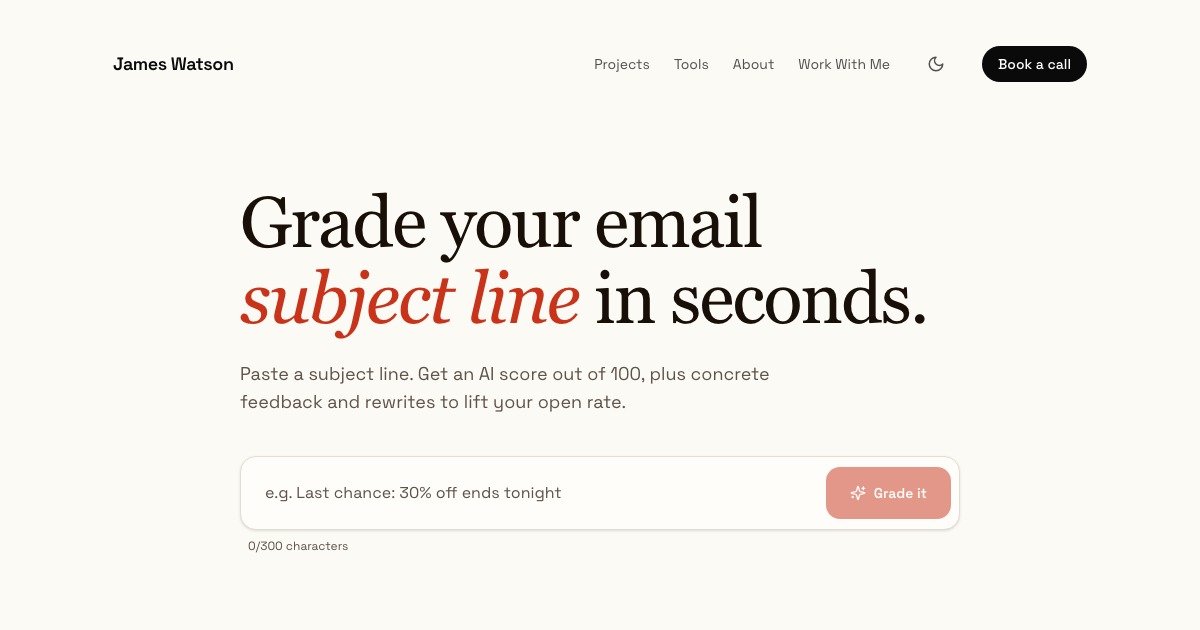
Just shipped my third free tool: the Subject Line Tester and Checker. Paste a line in and it’ll score it out of 100, tell you why, and give you three rewrites to try.
Try it here: jameswatson.com/email-subject-line-grader
It’s built for email but works for any message that needs a title - try it for your next like LinkedIn InMail.
In my experience, almost nothing about a good subject line has changed.
Spam filters are clearly better but the fundamentals haven’t moved much, yet hardly anyone studies them.
If your subject line doesn’t get opened, none of the rest matters, offer included.
Think of how much of marketing has changed in the last five years alone with new platforms and fancy tricks.
Email subject lines haven’t though, and they’re still what gets your emails opened.
My tool grades six things: clarity, curiosity, relevance, urgency, personalization, and length. They don’t carry equal weight, and urgency isn’t the one that matters most, which might surprise you.
Push the urgency too hard and you’ll trip spam filters instead of earning opens. Use it sparsely for maximum effect.
Curiosity does most of the work out of the six. When you tell someone exactly what’s in the email you’ve just killed their reason to open it.
Instead, leave something ‘unresolved’.
Thanks to the Zeigarnik effect, we’re hard-wired to want to close a loop in our mind rather than leave it open.
Length is simpler - shorter is better. 30 to 50 characters is what fits on a phone screen before it cuts off mid-thought.
Also - like it or not - adding personalization like first or business name still nudges the score up a little too.
Any score above 70 is a strong result. Here are four examples, from worst to best.
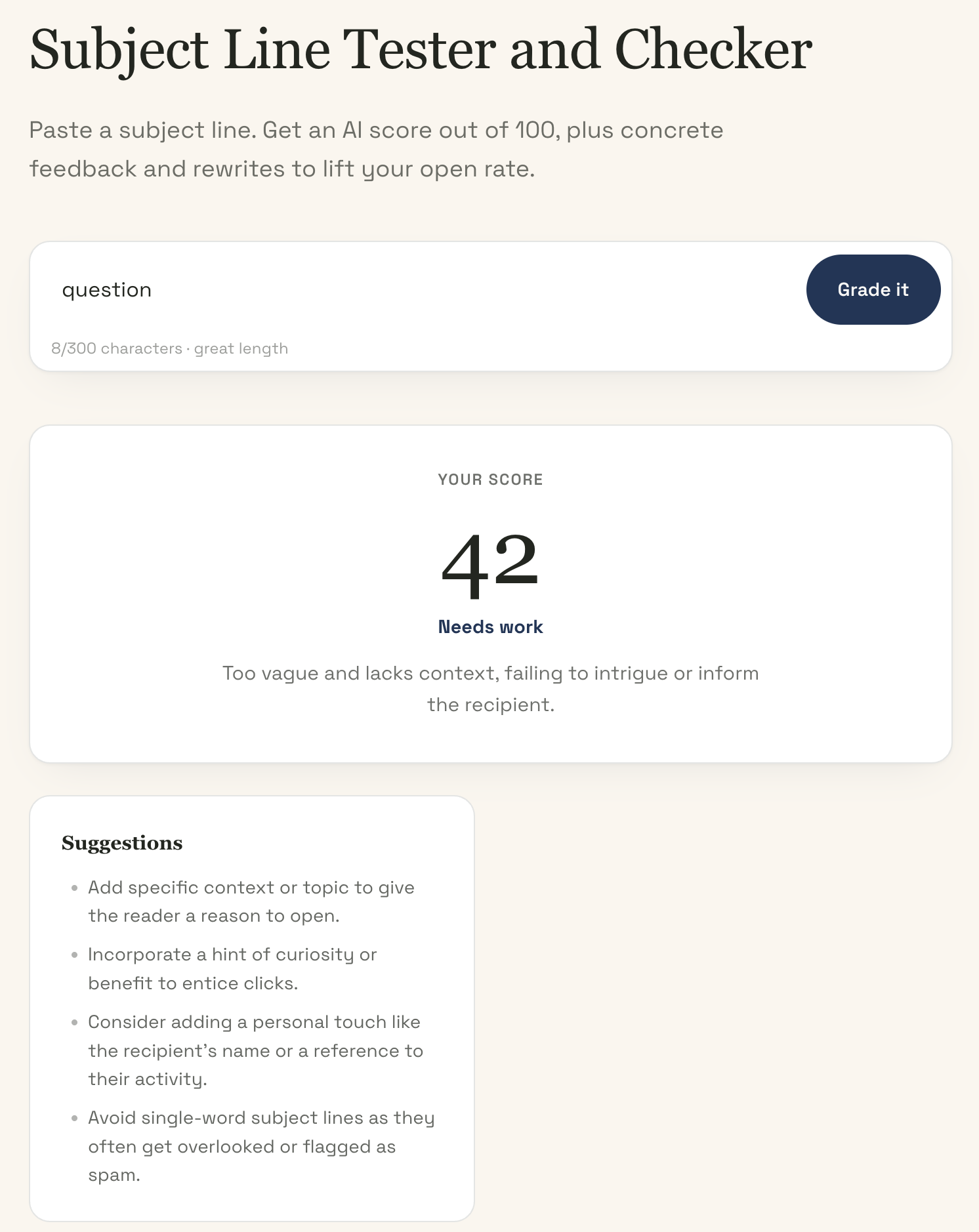
Just the word “question” pulls a 42. Too vague, no context, nothing to open for.
![Subject Line Tester and Checker scoring “A practical solution for [specific pain point]” at 72](/images/subject-line-checker-72.png)
“A practical solution for [specific pain point]” does better at 72, clear and relevant, but the bracket gives it away as a template.
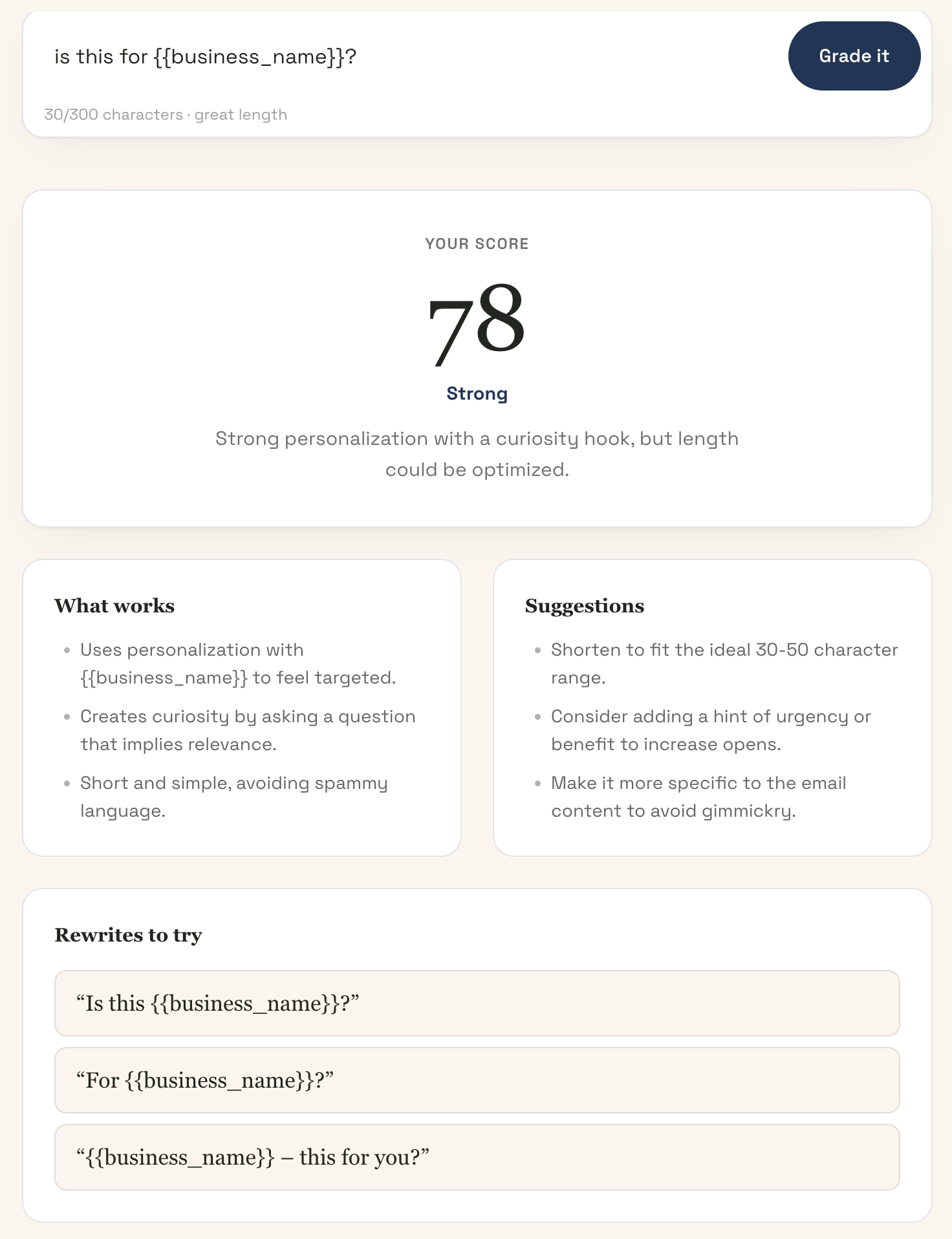
Add personalization and curiosity together and the number moves again. “is this for {{business_name}}?” sits at 78: it uses your name and asks a real question, which is hard to scroll past.
![Subject Line Tester and Checker scoring “Can I show you how [result]?” at 82](/images/subject-line-checker-82.png)
The best of the four, “Can I show you how [result]?”, lands at 82. Same idea, tighter phrasing, and it leaves you wanting to know what “result” means.
Bear in mind no tool knows your list.
It can tell you a line looks vague or leans on a placeholder, but it can’t tell you whether your own subscribers will open it anyway.
I run my own lines through it before I send and recommend you do too. Not because the score’s always perfect, but its an educated opinion worth knowing.
Go paste your next one in and see if you can beat your high score.
But be warned though, it gets addictive!